262-250-7566
 Request a quote
News & insights.
What we’re learning, what we’re seeing, and the occasional story from the floor: packaging trends, supply-chain notes, and compliance updates we wish we’d known sooner.
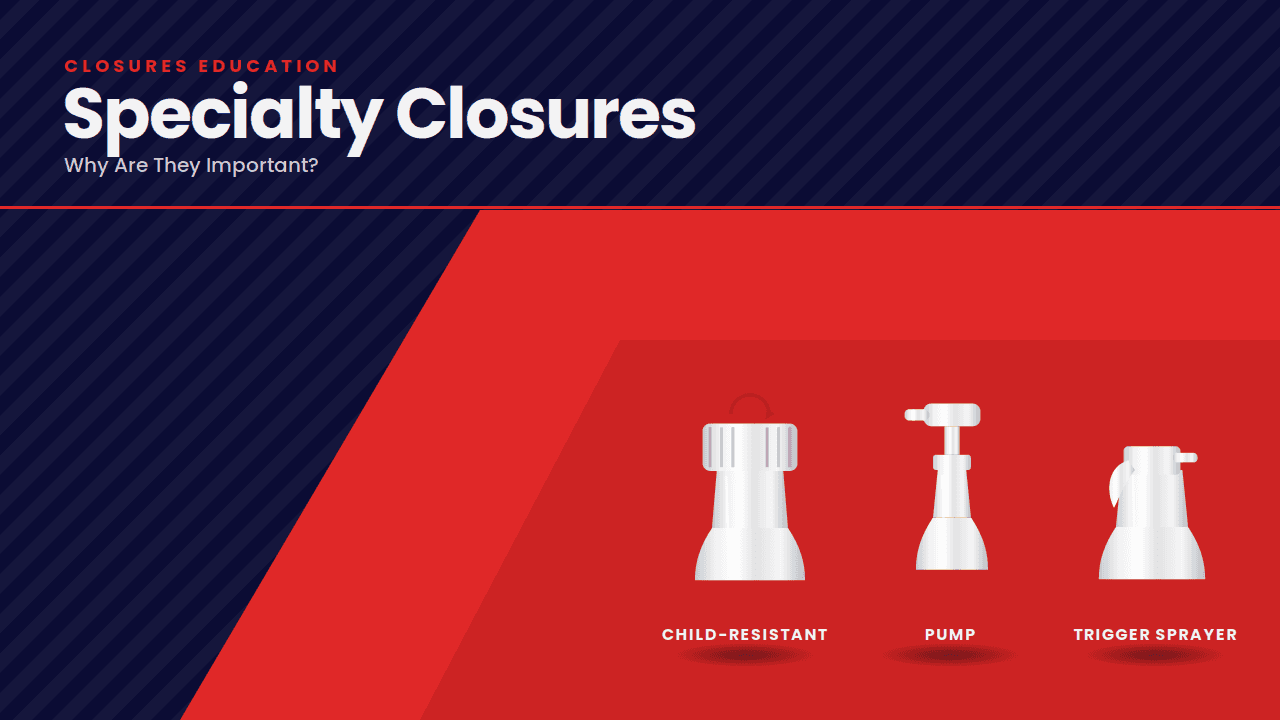
Why Are Specialty Closures Important?

Table of Contents
Most packaging decisions focus on the container, the size, the material, and the format. The specialty closure gets treated as an afterthought. It shouldn’t be. Specialty closures are what complete a packaging system. They prevent leakage, preserve freshness, support compliance and shape the consumer’s experience every time they open a product. Get the closure right and the rest of the system works. Get it wrong and it doesn’t matter how well-specified the container was.
This guide covers what specialty closures do, the most common types and where they are used, how liner selection fits into the equation, and what to confirm before committing to a production run. For broader context on building the right packaging partnership, see our guide How to Evaluate a Packaging Supplier.
What Specialty Closures Actually Do
A standard screw cap keeps a container closed. A specialty closure does significantly more and for regulated or performance-sensitive products, the difference is not cosmetic. It is functional, safety-critical, and in many cases legally required.
- Prevent leakage – A well-matched specialty closure keeps product safely container from the filling line to the delivery truck to the consumer’s shelf without seepage or failure under real-world handling conditions.
- Preserve product integrity – the right closure and liner prevent air, moisture, and containments from degrading what is inside. For food, pharmaceutical, and personal care products, that protection directly affects shelf life and product performance.
- Support compliance – The FDA, EPA, and DOT each set requirements that affect closure selection, child resistant caps for pharmaceuticals, vented closures for certain chemicals, tamper-evident features for food and drug products. A standard screw cap does not satisfy these requirements regardless of how well it fits the container.
- Signel quality – A pump that dispenses precisely, a flip-top that holds up over repeated cycles, a dropper that delivers a consistent does, there are the moments when the product’s quality is communicated directly to the person using it. The closure is often the first tactile interaction a consumer has with a product.
Common Specialty Closure Types
Closure Type | How It Works | Common Applications | Key Specification Factors |
Pumps | Delivers a measured dose per stroke via a dip tube and valve assembly | Serums, lotions, soaps, liquid pharmaceuticals | Output volume per stroke, dip tube length, neck finish, chemical compatibility |
Droppers | Delivers controlled drop-by-drop doses via a bulb and pipette | Tinctures, essential oils, liquid supplements, ophthalmic | Neck finish compatibility, pipette material, glass preferred for precision applications |
Trigger sprayers | Converts liquid to spray, stream, or foam via a trigger-actuated pump | Cleaners, agricultural products, industrial chemicals | Output volume, spray pattern, dip tube length, chemical compatibility |
Dispensing caps | Meters or controls flow for controlled dispensing without a pump mechanism | Sauces, condiments, adhesives, specialty chemicals | Orifice size, flow rate, container finish compatibility |
Child resistant caps | Requires coordinated multi-step action to open; certified as complete system | Pharmaceuticals, household chemicals, pesticides, cannabis | PPPA compliance, certification as cap-and-container system, testing requirements |
Tamper-evident closures | Provides visible evidence of first opening through a breakaway band or seal | Food, pharmaceutical, personal care, OTC products | Band integrity, liner compatibility, regulatory requirements by product category |
Vented closures | Allows controlled pressure equalization to prevent container deformation | Certain chemicals, fermentation products, reactive formulations | Venting rate, chemical compatibility, container and product requirements |
Compatibility is Everything
The most important factor in any specialty closure selection is compatibility with the container, the product, the fill process, and the end use environment. A closure that performs well in one application can fail in another. Bloating, paneling, evaporation, or leakage after sealing are all signals that the closure is not right for the system, not that the system is otherwise fine.
Compatibility evaluation must cover every component in contact with the product or the sealing surface:
Neck finish – every specialty closure is designed for a specific finish size. The cap must match the container’s thread style and diameter exactly to seat and seal correctly.
Chemical compatibility – The cap body, dip tube, gasket, and liner must all be compatible with the product formulation not just the container dimensions. Aggressive chemicals, solvents, and reactive formulations require verified material compatibility for every component.
Fill process - Hot fill, cold fill, induction sealing, and aseptic filling each impose different requirements on closure performance. Confirm that the specialty closure you select is rated for your specific process.
End use environment – storage temperature, shipping conditions, shelf-life requirements, and consumer handling patterns all affect how a closure performs over time.
The best way to avoid compatibility problems is to source the closure and container through the same partner, confirm compatibility before committing to a production run, and test the full system not just the individual components.
Liner Selection
Liner selection is a core part of the specialty closure compatibility equation, not an add-on decision made after the cap is chosen. The liner is typically wat creates the actual seal between the closure and the container, and the wrong liner material can compromise performance regardless of how well the cap fits.
Common liner types and their applications:
- Pressure – sensitive foam liners – adhere to the container rim on contact; well-suited for nonperishable liquids, dry products, and powders where a standard compressible seal is sufficient.
- Heat-seal / induction seal liners – create an airtight foil bond using induction sealing equipment; right for applications requiring full leak protection, tamper evidence, and extended shelf life.
- PTFE and specialty liners – handle aggressive chemicals, solvents, and high-temperature applications where standard liner materials would degrade or contaminate the product.
- Plastisol liners – widely used om food and beverage applications, compatible with hot fill and vacuum sealing processes.
Before You Spec a Specialty Closure
Specifying a specialty closure before verifying compatibility across the full system is one of the most common and costly mistakes in packaging development. Two steps prevent most problems:
- Confirm neck finish and chemical compatibility first. Every specialty closure is designed for a specific finish size. The cap body, dip tube, gasket, and liner must all be compatible with the product formulation not just the container dimensions. Confirm both before moving forward.
- Test the full system before committing to volume. Request samples of the complete packaging system, closure, liner, and container together, before placing a production order. Compatibility issues surface under real fill and storage conditions, not on a spec sheet. Testing the system, rather than validating components individually, is the only reliable way to confirm performance before production begins.
The right specialty closure is the difference between a packaging system that works and one that creates problems after the order ships. Getting there requires treating the closure as a system decision, not an afterthought selected after everything else has been locked in.
Where ILLING Fits In
ILLING has been helping customers navigate specialty closure and liner selection across dozens of product categories for nearly 100 years. We don’t consider the job done until the full system is confirmed to perform from the container finish through the liner, the closure, and the fill process.
Whether your application calls for pumps, droppers, trigger sprayers, child resistant caps, or tamper-evident solutions, our team brings the experience and extraordinary attention needed to help you make the right packaging decisions. Because business is personal, we focus on solutions that fit your product, your process, and your long-term goals.
FAQs
What Is a Specialty Closure?
A specialty closure is any closure that goes beyond a standard screw cap to provide additional functionality, such as controlled dispensing, child resistance, tamper evidence, pressure equalization, or precision dosing. Specialty closures are used when product safety, compliance requirements, consumer experience, or performance demands require more than a basic cap can deliver.
What Is the Difference Between a Pump and a Dropper Closure?
A pump closure delivers a fixed, metered volume of product per stroke through a dip tube and valve mechanism typically used for lotions, serums, soaps, and liquid pharmaceuticals where consistent dose delivery matters. A dropper closure delivers product drop by drop via a bulb and pipette, providing more manual control over individual doses. Droppers are common for tinctures, essential oils, and precision pharmaceutical applications where glass containers are often preferred for compatibility.
Why Does Liner Selection Matter for Specialty Closures?
The liner is typically what creates the actual seal between the closure and the container. The wrong liner material can allow leakage, product degradation, or contamination regardless of how well the cap fits. Liner selection must account for the product formulation, fill temperature, shelf-life requirements, and any tamper-evidence or compliance needs. Pressure-sensitive foam, induction seal foil, plastisol, and PTFE liners each serve different applications matching the liner to the system is as important as matching the cap.
When Is a Vented Closure Required?
Vented closures are used when a product or container generates internal pressure during storage or transport, such as certain chemicals, reactive formulations, fermentation products, or containers exposed to significant temperature variation. Without controlled venting, pressure buildup can deform the container, cause leakage, or create a safety hazard. Whether a vented closure is required depends on the product chemistry, fill conditions, and storage environment.
How Do I Confirm That a Specialty Closure Is Compatible With My Product?
Start by confirming that the container neck finish matches the closure specification. Then verify that every component in contact with the product, cap body, dip tube, gasket, and liner is chemically compatible with the product formulation. Finally, test the complete system under real fill and storage conditions before committing to a production run. Compatibility issues that appear after production begins are significantly more costly to resolve than those caught during system validation.