262-250-7566
 Request a quote
News & insights.
What we’re learning, what we’re seeing, and the occasional story from the floor: packaging trends, supply-chain notes, and compliance updates we wish we’d known sooner.
What Is the Difference Between Continuous Thread & Lug Metal Caps?

Table of Contents
Metal caps both continuous thread and lug styles may look similar at first glance, but they are built for different container finishes, filling processes, and product needs. Choosing between continuous thread vs. lug metal caps matters because it directly affects seal performance, line compatibility, user experience, and overall product protection. Getting the right cap on the right container is one of the most fundamental decisions in packaging a product correctly.
This guide breaks down how each style works, where each one is the better choice, and what to evaluate when selecting a metal cap for your application. For a broader overview of closure formats, check out continuous thread closures.
How Continuous Thread Caps Work
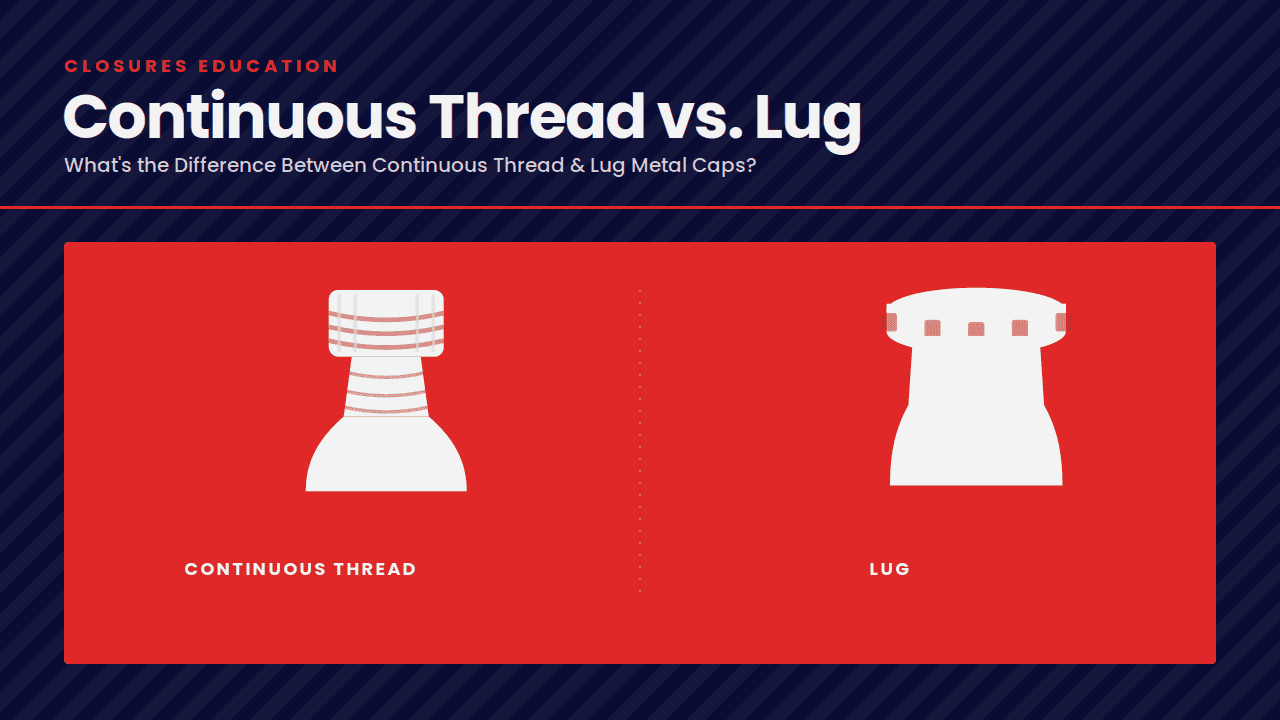
Continuous thread caps use one uninterrupted helical thread that twists onto a matching threaded container neck. As the cap turns clockwise, it draws down onto the container and compresses the liner against the sealing surface, creating a reliable seal that holds through storage, shipping, and consumer handling.
This style is commonly selected when a secure, repeatable reseal is important where the end user needs to open and reclose the container multiple times without compromising performance. Continuous thread metal caps are widely used on bottles and jars for food, beverage, personal care, chemical, and specialty applications.
Continuous thread caps are commonly used for:
- Sauces, condiments, and liquid food products
- Pharmaceutical and supplement bottles
- Personal care and beauty products
- Specialty chemical and industrial containers
- Any application where repeated consumer reseal is a priority
How Lug Caps Work
Lug caps use short, interrupted thread segments called lugs that lock onto matching raised lugs on the container neck. Rather than rotating multiple full turns like a continuous thread cap, a lug cap typically requires only a partial turn around a quarter to a third of a full rotation to fully engage or release.
This partial-turn design makes lug caps a practical choice for high-speed filling operations, where faster application and removal translate directly to line efficiency. It also makes lug caps easy for consumers to open, which is a meaningful advantage for food products intended for everyday household use.
Lug caps are commonly used for:
- Glass jars for food products, sauces, and spreads
- Pickled and preserved items
- Jellies, jams, and fruit spreads
- Any application where efficient filling speed and easy consumer opening are priorities
Side-by-Side Comparison
| Factor | Continuous Thread Cap | Lug Cap |
|---|---|---|
| Thread style | Full continuous helix | Short interrupted lugs |
| Turns to open/close | Multiple full rotations | Quarter to third turn |
| Container compatibility | Threaded neck finish | Lug neck finish |
| Filling line speed | Standard | Faster fewer turns required |
| Consumers reseal | Excellent secure thread engagement | Good quick and easy |
| Common applications | Bottles, jars, food, pharma, chemical | Glass food jars, sauces, preserved goods |
| Interchangeable? | No each requires its matching container finish | |
Why Metal Caps Matter
Metal caps offer dependable strength, barrier protection, and strong shelf presentation that plastic closures often cannot match. They help protect products from oxygen, moisture, and outside contaminants while supporting a clean, premium finished look that communicates quality on the shelf.
Beyond aesthetics, metal closures provide meaningful performance advantages in demanding packaging environments. They support hot fill and other elevated-temperature processes when properly matched to the container, liner, and application making them a go-to choice for food products that require thermal processing after filling.
Key advantages of metal caps include:
- Strong oxygen and moisture barrier performance
- Compatibility with hot fill, retort, and vacuum sealing processes
- Premium shelf appearance that supports brand presentation
- Durable construction that holds up through distribution and retail handling
- Wide availability across standard finish sizes for both continuous thread and lug configurations
Choosing the Right Cap
Continuous thread caps and lug caps are not interchangeable. Each requires the correct container finish to perform properly and using the wrong cap on the wrong container will result in a poor seal, application problems on the filling line, or a consumer experience that falls short of expectations.
- Know your container finish. Confirm whether your container has a continuous thread neck finish or a lug finish before selecting a cap. These are two distinct systems and cannot be mixed.
- Evaluate your filling process. High-speed filling operations may favor lug caps for their faster application. Confirm that your capping equipment is compatible with the cap style you select.
- Consider your product requirements. Hot fill, vacuum seal, and retort applications each have specific requirements for cap and liner performance. Verify that the metal cap and liner combination you select is rated for your process.
- Select the right liner. The liner inside the metal cap is what creates the actual seal. Foam liners, plastisol liners, and specialty materials each perform differently match the liner to your product, fill temperature, and shelf-life requirements.
- Think about consumer experience. Consider how the end user will open and reseal the product. Continuous thread caps offer more secure reseal; lug caps offer quicker, easier access. Neither is universally better the right choice depends on the application.
The cap, container, and liner should always be evaluated together as one complete packaging system. Selecting any component in isolation increases the risk of compatibility issues that only show up after production has begun at which point they are costly to correct.
Why Choose ILLING?
At ILLING, we help customers identify metal cap solutions including continuous thread and lug styles that support product protection, operational efficiency, and reliable performance from filling through distribution.
For nearly 100 years, businesses have trusted ILLING to provide dependable packaging solutions backed by expertise, responsiveness, and Extraordinary Attention. Because business IS personal, we focus on solutions that fit your product, your process, and your long-term goals not just the next product off the shelf.
FAQs
What Is the Difference Between a Continuous Thread Cap and a Lug Cap?
A continuous thread cap uses one uninterrupted helical thread that requires multiple full rotations to apply or remove. A lug cap uses short, interrupted thread segments that engage with matching lugs on the container neck and require only a partial turn, typically a quarter to a third of a rotation, to open or close. Each style requires its own specific container finish and the two are not interchangeable.
Can I Use a Lug Cap on a Continuous Thread Container?
No. Lug caps and continuous thread caps require different container neck finishes. Attempting to use one style on the wrong container will result in poor fit, inadequate sealing, and potential line failures. Always confirm the container finish before selecting a cap style.
Why Choose Metal Caps Over Plastic Closures?
Metal caps offer stronger barrier performance against oxygen and moisture, better durability through distribution and retail handling, and a premium shelf appearance that plastic closures often cannot match. They also support demanding fill processes, including hot fill, retort, and vacuum sealing, when properly matched to the container and liner.
Which Cap Style Works Better on a High-Speed Filling Line?
Lug caps are generally more efficient on high-speed lines because they require only a partial turn to apply, reducing cycle time compared to continuous thread caps. That said, the right choice depends on your container finish, product, and process, not filling speed alone.
What Liner Should I Use Inside a Metal Cap?
The right liner depends on your product, fill temperature, and shelf life requirements. Plastisol liners are widely used in food applications and are compatible with hot fill and vacuum sealing. Foam liners provide a compressible seal for ambient-temperature products. Specialty liners are available for chemical and pharmaceutical applications with specific compatibility requirements.