262-250-7566
 Request a quote
News & insights.
What we’re learning, what we’re seeing, and the occasional story from the floor: packaging trends, supply-chain notes, and compliance updates we wish we’d known sooner.

Continuous Thread: How Do They Work?

Table of Contents
Continuous thread closures are among the most widely used closure systems in packaging today. Found on glass and plastic containers across food, beverage, chemical, personal care, pharmaceutical, and industrial markets, they provide a dependable sealing solution that is both simple in design and reliable in performance. Understanding how continuous thread closures work and what makes a complete, compatible system, is key to selecting the right solution for your product.
While these closures may seem straightforward, the interaction between the cap, liner, and container finish determines whether you're packaging actually performs. This guide walks through how continuous thread closures work, what affects seal quality, and how to evaluate the right combination for your application.
What Is a Continuous Thread Closure?
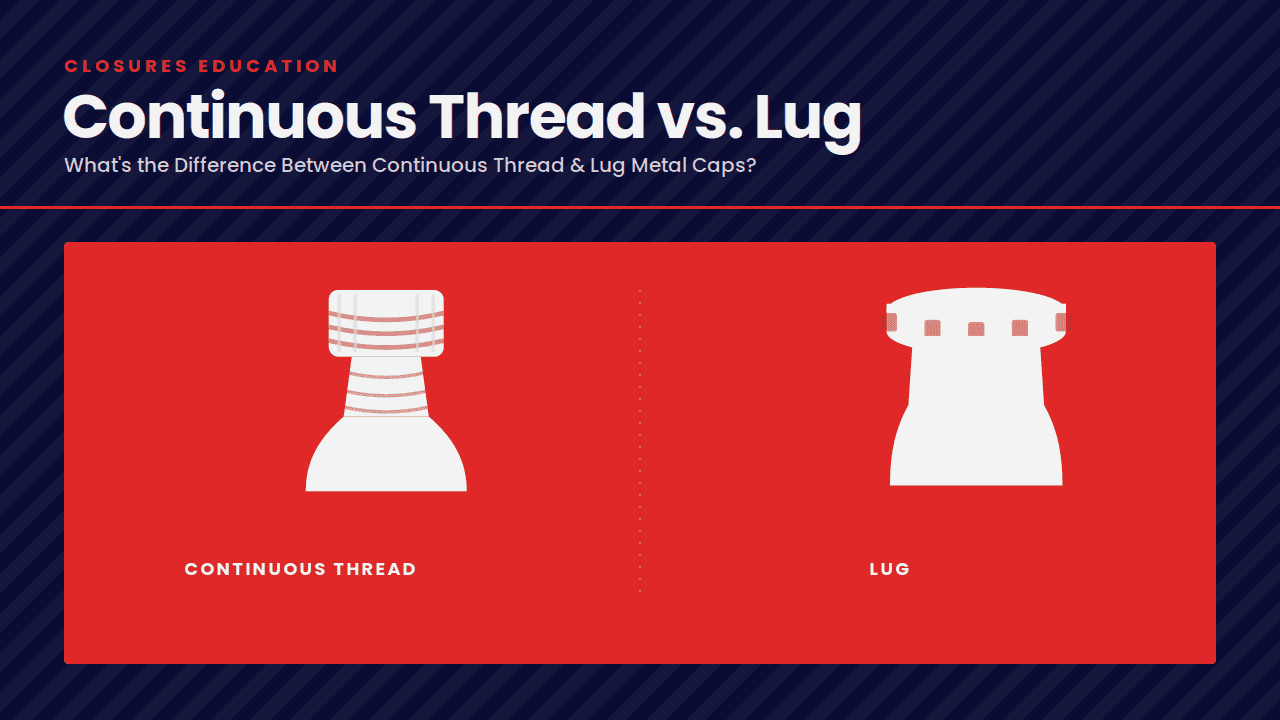
A continuous thread closure uses matching threads on both the container neck and the inside of the cap. When the cap is turned clockwise, the threads engage and pull the closure downward onto the container. As the closure tightens, the liner inside the cap compresses against the container opening, creating a seal that helps protect the product inside.
To open the package, the cap is simply turned counterclockwise, allowing the threads to disengage. The result is an intuitive, reliable open-and-close mechanism that consumers across virtually every market recognize and use daily.
Because of their ease of use, versatility, and wide availability across sizes and materials, continuous thread closures are the most common closure format in packaging, used on everything from food jars and beverage bottles to pharmaceutical containers and industrial chemical packaging.
How the Seal Is Created
While the threads secure the closure to the container, the liner is typically what creates the actual seal. As the cap tightens, it applies downward pressure while the liner conforms to the sealing surface of the container opening. Together, these components protect against leaks, contamination, moisture ingress, and air exposure.
The quality of the seal depends on several factors working together correctly:
- The flatness and smoothness of the container's sealing surface
- The liner material and its ability to conform to the finish
- The torque applied during capping, too little and the seal is incomplete, too much and the liner or container can be damaged
- Compatibility between the liner material and the product being packaged
Selecting the right closure and liner combination is one of the most important steps in building a packaging system that performs reliably from filling through distribution.
Understanding Container Finishes
For a continuous thread closure to work properly, the closure and container must be compatible. Container finishes are identified using a standard numbering system, such as 28-400 or 38-400. The first number identifies the neck diameter in millimeters, while the second identifies the thread style.
Both measurements must match for the closure and container to fit and function correctly. Using a closure with an incompatible finish will result in poor sealing, cross-threading, or a cap that does not seat properly all of which can compromise product protection and shelf integrity.
| Finish (Example) | Neck Diameter | Common Applications |
|---|---|---|
| 18-400 | 18mm | Small bottles, essential oils, tinctures |
| 24-400 | 24mm | Personal care, pharmaceutical, food |
| 28-400 | 28mm | Beverage, food, household products |
| 33-400 | 33mm | Food jars, sauces, condiments |
| 38-400 | 38mm | Wide-mouth jars, food, personal care |
| 53-400 | 53mm | Large jars, food, industrial |
| 70-400 | 70mm | Wide-mouth food jars, bulk products |
ILLING offers closure options designed to fit many common container finishes used throughout the packaging industry, making it straightforward to find a compatible solution for your container.
Liner Options Matter
Different products require different sealing solutions, and the liner inside a continuous thread closure plays a critical role in determining overall package performance.
Common liner types and their applications include:
- Foam liners — provide a compressible seal suitable for a wide range of dry and liquid products; available in polyethylene foam and other materials depending on product compatibility
- Induction seal liners — used with induction sealing equipment to create a foil-based hermetic seal that supports tamper evidence and extended shelf life
- Pressure-sensitive liners — adhere to the container finish on contact without heat, suitable for certain food and personal care applications
- Specialty liner materials — fluoropolymer and other chemical-resistant liners for aggressive or reactive products
Choosing the right liner helps support product integrity, tamper evidence, and overall package performance throughout storage and distribution. Because every application is different, evaluating the complete packaging system, not just the cap is essential when selecting a closure solution.
Why Compatibility Is Important
A successful closure system involves more than selecting a cap that physically fits. The closure, container, liner, and product must all work together to achieve the desired performance. Mismatches between any of these components can result in leaks, seal failures, product contamination, or poor consumer experience.
Considering compatibility early in the packaging process helps reduce these risks and supports operational efficiency throughout filling, storage, and distribution. Key compatibility factors to evaluate include:
- Container finish and closure fit. Confirm that the finish designation of the container matches the closure specification exactly both diameter and thread style.
- Liner and product compatibility. Verify that the liner material will not react with or be degraded by the product being packaged, particularly for chemical, pharmaceutical, or food applications.
- Fill process requirements. Hot fill, cold fill, and aseptic filling processes each have different requirements for closure and liner performance. Select accordingly.
- Torque specifications. Work with your filling line team to confirm that application torque is within the recommended range for the closure proper torque is essential to seal integrity.
- Tamper evidence requirements. If your product or market requires tamper-evident packaging, confirm that the closure system includes an appropriate tamper-evident feature such as an induction seal, breakaway band, or shrink sleeve.
At ILLING, we help customers identify closure and container combinations designed to work together seamlessly and support long-term packaging success from the production line through the end consumer.
Why Choose ILLING?
ILLING offers a broad range of closure solutions to support food, beverage, chemical, pharmaceutical, personal care, and industrial packaging applications. From continuous thread closures and dispensing caps to child resistant and specialty closure options, our team helps customers find solutions tailored to their specific needs.
For nearly 100 years, businesses have trusted ILLING to provide dependable packaging solutions backed by expertise, responsiveness, and Extraordinary Attention. Because business IS personal, we focus on helping customers find the right solution not just the next product.
FAQs
What Is a Continuous Thread Closure?
An continuous thread closure is a cap that uses matching helical threads on both the cap and the container neck to create a secure, resealable seal. Turning the cap clockwise engages the threads and pulls it down onto the container, compressing the liner against the opening. Turning counterclockwise releases the cap. This is the most widely used closure format across food, beverage, pharmaceutical, chemical, and consumer product packaging.
What Does the Container Finish Number Mean?
Container finish numbers such as 28-400 or 38-400 identify the neck specification of a container. The first number is the outer diameter of the neck in millimeters. The second number identifies thread style, which determines the pitch and depth of the threads. Both numbers must match between the container and closure for the system to fit and seal correctly.
What Is the Difference Between a Foam Liner and an Induction Seal Liner?
A foam liner sits inside the cap and creates a compressible seal when the closure is tightened against the container finish. It does not require special equipment to activate. An induction seal liner uses a foil layer that bonds to the container opening through electromagnetic induction during the capping process, creating a hermetic seal that provides tamper evidence and longer shelf life. Induction sealing requires compatible equipment on the filling line.
How Do I Know Which Closure Fits My Container?
Match the finish designation on your container to the closure specification. The finish number printed on the container or provided by the container manufacturer tells you the neck diameter and thread style. A closure with the same finished designation will fit correctly. If you are unsure, your packaging supplier can help verify compatibility before you commit to a full production run.
What Industries Use Continuous Thread Closures?
Continuous thread closures are used across virtually every packaging market, including food and beverage, pharmaceuticals, personal care and beauty, household and specialty chemicals, agricultural products, nutraceuticals, and industrial applications. Their versatility, availability across a wide range of sizes and materials, and ease of consumer use make them the most common closure format in packaging.