262-250-7566
 Request a quote
News & insights.
What we’re learning, what we’re seeing, and the occasional story from the floor: packaging trends, supply-chain notes, and compliance updates we wish we’d known sooner.
Understanding UN Marking on Hazardous Materials Packaging

It is the responsibility of the users to select and designate the appropriate package rating based upon their product and chemistry. A description of the UN specification markings can be found in every transport regulation or standard. For example:
UN Recommendations on the Transport of Dangerous Goods – Part 6
IATA – Dangerous Goods Regulations (DGR)
ICAO Technical Instructions – Part 6
Canadian CGSB – CGSB-43.150-97, section 4 (small means of containment); CGSB-43.146-2002, section 5 (IBC’s)
The marking that is applied to a UN package indicates the type of package and the levels to which the packaging has been approved. The following describes the sequence of numbers and letters that appear in a UN marking and what they designate.
Combination Packaging or Single Packaging for Solid Hazardous Materials
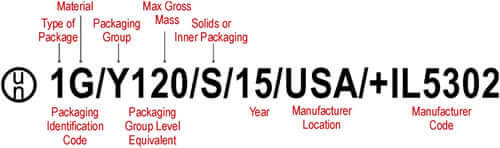
Example of UN Marking for Solid Hazardous Materials in single or composite packaging or combination packaging for all materials.
Liquid Hazardous Materials
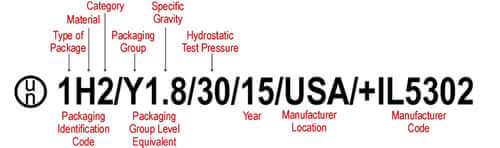
Example of UN Marking for Liquid Hazardous Materials in single or composite packaging.
UN Marking Code
| Character | Description |
|---|---|
| Type of Package | 1 - Drums, 2 - Barrels, 3 - Jerrycans, 4 - Boxes, 5 - Bags, 6 - Composite Packaging |
| Material | A - Steel, B - Aluminum, C - Natural Wood, D - Plywood, F - Reconstituted Wood, G - Fiberboard, H - Plastic, L - Textile, M - Paper/Multiwall, N - Metal other than Steel or Aluminum, P - Glass, Porcelain or Stoneware |
| Category | 1 - Closed Head, 2 - Open Head |
| Packaging Group | X - Packaging Groups I, II, and III, Y - Packaging Groups II and III, Z - Packaging Group III only |
| Density or Specific Gravity | Density – Solids or packaging that have inner packaging must be marked with the maximum gross mass (weight) in kilograms. Specific Gravity – Stand-alone packaging intended to contain liquids must be marked with the specific gravity rounded down to the first decimal. |
| Solids or Inner Packaging | Solids – An "S" in upper case should follow the density. Liquids – Should reflect the Hydrostatic test pressure in kPa (kilopascals), rounded down to the nearest 10 kPa. |
| Year of Manufacture | The last two digits of data indicate the year the packaging was manufactured. |
| Location of Manufacture | Country where the item was manufactured. |
| Manufacturer Code | Code for UN certifying agency or manufacturer. |
Of the six types of UN Packaging, the most common are drums (including pails), barrels and Jerrycans.
First let’s look at a hypothetical example of UN Marking for Solid Hazardous Materials in single or composite packaging for all materials.
The first digit references the type of solid hazardous materials package, in this case, a drum. The second indicated the drum material—fiberboard. The third indicates the category within the packaging type, Open Head or Closed Head, in this case open. The drum falls in to Packaging Group Y (Group II or III) with a maximum mass gross weight of 120kg. Bulk density is used with solid applications. Next, the marking indicates a solid single application, followed by the year of manufacture, 2015, the country of origin, USA, and the manufacturer code.
In short, we have a fiber drum, solid rated with a max density of 120kg, made by the listed American manufacturer in 2015.
Next, we’ll look at an example of a UN Marking for Liquid Hazardous Materials. The first digit references the type of liquid hazardous materials package, again in this case, a drum. The second indicates the drum material—plastic. The third indicates an “open head” package. The drum again falls in to Packaging Group Y (Group II or III) with a product specific gravity rating of 1.8. The drum is rated at 30kPa, or Kilopascals, a value used to measure static pressure. Next, the marking indicates the year of manufacture, 2015, the country of origin, USA, and finally the manufacturer code.
In summary, we have a liquid plastic open head drum, with a specific gravity rating of 1.8 and 30kPA, made by the listed American manufacturer in 2015.
For more information on which product is right for you, please consult with your regulatory specialist, consult the links on our webpage or contact one of our Packaging Specialists.
Tips for Choosing the Right UN Packaging
Selecting compliant packaging doesn’t have to be complicated once you know what to look for. Keep these points in mind when reviewing a UN Marking on any container.
- Match the packaging group (I, II, or III) to your product’s hazard classification.
- Confirm the drum or container material (fiberboard, plastic, steel, etc.) is compatible with your product’s chemistry.
- Check the specific gravity or bulk density rating listed in the marking against your product’s specifications.
- Note the manufacturing date and country of origin codes to confirm the packaging is still valid for use.
- When in doubt, consult a regulatory specialist or packaging provider before shipping.
FAQs
What is UN-Rated packaging?
UN-Rated packaging is certified by a national competent authority through design qualification testing to meet United Nations specifications for containing dangerous goods.
Who is responsible for choosing the right UN packaging rating?
Users are responsible for selecting and designating the appropriate package rating based on their product and its chemistry, guided by applicable transport regulations.
What does a UN marking on a package indicate?
A UN marking shows the type of package and the level to which it's been approved, using a sequence of numbers and letters that designate details like material, packaging group, and manufacturing information.
What are the most common types of UN Packaging?
Of the six types of UN Packaging, the most common are drums (including pails), barrels, and Jerrycans.
Where can I get help choosing the right UN packaging?
You can consult a regulatory specialist, review the regulatory links in this article, or contact one of ILLING Packaging's Packaging Specialists.