262-250-7566
 Request a quote
News & insights.
What we’re learning, what we’re seeing, and the occasional story from the floor: packaging trends, supply-chain notes, and compliance updates we wish we’d known sooner.

Bottle and Pail Quality: A Packaging Defects Guide

When choosing a supplier, we know that value chain experts require on-time delivery of quality product—from bottle quality to pail quality—and ILLING Packaging has built our business around this need.
Our purchasing and production teams are dedicated to making sure that ILLING Packaging delivers consistent, high quality product. This begins with a trained professional sales and customer service group to ensure your needs are clearly understood and matched with the right products and suppliers.
ILLING Packaging has expertise in all aspects of Total Quality System development. Our dedicated professionals ensure the entire value chain is operating with quality in mind and we leverage over 100 years of combined experience in glass, plastic, and metal containers with direct links to every tier one manufacturer.
Bottle Quality
Neck Finish
When determining the compatibility of continuous thread (CT) closures, it is important that both the bottle neck and closure have the same finish. The finish of a CT bottle is composed of two numbers separated by a hyphen, such as 28-400:
- First number: the outside thread diameter of the container in millimeters.
- Second number: the thread style or finish, which determines the number of turns required to seat the closure on the container.
If these numbers do not match, the security of the closure may be compromised resulting in leaking package. A lower closure finish number (400) may be paired with a higher neck finish (410) but the closure will sit high on the neck and not cleanly against the transfer bead.
Uniform standards for neck finishes for plastic bottles have been set by The Society of the Plastics Industry (SPI). The closure industry doesn’t always adhere to SPI standards so it is important that the bottle and closure are tested together prior to ordering.
Liners
Liners are an important part of the complete package and help ensure containers keep contents secure for freshness and protection, to prevent leaks, to allow product venting or to provide tamper evidence. Leaking can occur for a range of reasons:
- Liner/Bottle incompatibility: Induction seal liners need to be compatible with the bottle to which they will be sealing. A liner intended for HDPE may not engage on a PET container
- Landing seal—this area of the bottle neck needs to be designed to be flat and consistent enough to ensure proper adhesion
- Cap/Bottle incompatibility—Improper thread patterns can prevent a closure from properly engaging with the bottle
- Induction Seal settings—Induction sealing equipment must be properly calibrated and the environment must be consistent for your application
- Product contents—the product packaged in the bottle can have an adverse effect on liner performance
- Foam liners are common but are not a hermetic seal and can leak
Charring
Charring occurs when burnt fragments of plastic accumulate in the mold, break free during production and appear in the bottle as black specks. Proper mold maintenance and quality inspection is key to minimizing the occurrence in production.
Flashing/Parting Line
Flashing occurs when plastic resin is not properly contained in the mold due to part misalignment, mold wear and/or improper production settings. This can result in thin strips of plastic at the parting lines where the two mold pieces joint together.
Pinholes
Pinholes are tiny holes that can occur in a bottle due to improper mold flow, resulting in leaky packages. Many bottle producers utilize in-line leak-check equipment to ensure bottle integrity.
Pail Quality
Point Loading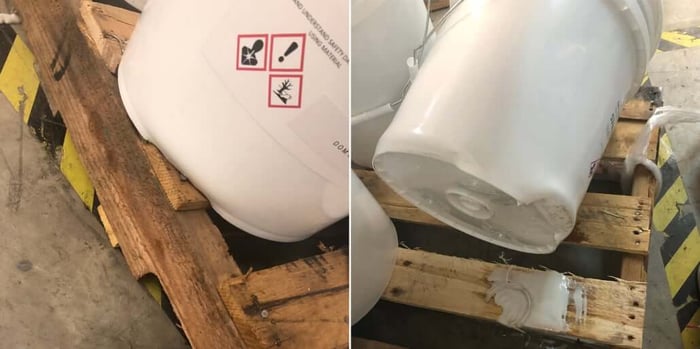
Main contributors to Point Load:
- Pallet design/Condition
- Pail placement on pallet
- Placement of upper pallet upon lower pallet
Point Load manifests itself as:
- Collapse/dent/buckling in pail sidewall
- Bending inward of pail bottom (chime)
- Container bulging
How to tell where uneven force is being applied:
- Lower sidewall dent/collapse = Pallet related (excessive spacing or pail overhand)
- Upper sidewall near satellite = Placement of upper pallet
Point Load can lead to:
- Permanent deformation of pail
- Dent/buckling turns into crack—product spillage
- Pallet collapse as load shifts
- External stress point—ESC failure
- Loss of compression strength—reduction in pallet stacking capability = $$
Test Results
| Item# | Test Condition | Average Peak Load at Failure | Loss of Compressive Strength (lbs.) | % Loss of Compressive Strength |
|---|---|---|---|---|
| 1 | Top Center Load | 3813 lbs. | — | — |
| 2A | Bottom 2° Overhang | 2152 lbs. | -1661 | -43.6% |
| 2B | Bottom 1° Overhang | 2681 lbs. | -1132 | -29.7% |
| 3 | Top Eccentric Load | 1897 lbs. | -1916 | -50.2% |
| 4A | 5″ Deck Board Space | 2617 lbs. | -1196 | -31.4% |
| 4B | 3″ Deck Board Space | 3115 lbs. | -698 | -18.3% |
| 4C | 2″ Deck Board Space | 3336 lbs. | -477 | -12.5% |
| 5 | 3/8″ Deck Board Deflection | 2278 lbs. | -1535 | -40.3% |
Pail Quality: Material Performance Factors
Effects of Fill Temperature on Pail Stiffness
Two Considerations:
- Loss of stiffness as a function of temperature
- The stiffness of PE at 140° is 1/2 of that at 73°.
- Types of hot fill—pie fillings, flavorings, sauces, driveway sealers.
- Maximum use temperature is 160°. At this temperature some annealing may take place resulting in shrinkage, warpage deformation.
- Pails should not be stacked more than two high.
- Vacuum generation
- The contraction of contents upon cooling will create a vacuum.
- Extent of vacuum dependent on headspace and lid seal efficiency. Pail sidewalls give the appearance of being “sucked in”. Stacking should be minimized during the cooling phase.
Environmental Stress Cracking (ESC)
ESC is a type of failure that occurs in molded plastic containers and covers when specific conditions are present.
How Does ESC Occur?
Failure is usually initiated on the surface of a molded part that is under stress and in contact with an aggressive fluid, which promotes initiation and crack propagation. Two other factors influence how quickly this happens:
- Time: Failure is primarily a function of plastic under stress exposed to certain fluids over a period of time.
- Heat: The addition of heat (e.g. hot warehouse conditions during the summer) will accelerate failures because of the reduction of pail stiffness, thereby increasing stress.
What Does an ESC Failure Look Like?
The failure starts out as a small smooth crack. Under load, the crack will propagate in a tearing manner. Failures are usually found in containers located in the bottom row of a pallet. Once one package fails it’s common for the load to shift in the pallet resulting in a number of containers toppling over.
What are Some Sources of Stress?
There are two type of stresses—External and Internal (molded).
Sources of external stresses include:
- excessive stack load
- point load
- overhand on the pallet
- too much space between pallet boards
- compression through tight stretch wrapping and banding.
- small cover on large pail will introduce compressive forces in the satellite ring area
- mold design/construction—sharp angles, ribs in the parts
- nicks, cuts, pits in the molded parts
Sources of internal stresses (molding related) include:
- short shots in ribs
- gate area (high stress point)
- flawed processing set-up introduces stress—fill velocity, packing pressure, hold time, cooling
- resin (higher melt and density)—certain resins are more susceptible to failure
- colorants—too much color makes parts brittle
What is Environmental Stress Cracking Resistance (ESCR)?
Environmental Stress Crack Resistance (ESCR) is a measure of the resistance of plastics to failure in this mode:
- To check how well plastic will perform with a specified liquid, two types of lab tests based on ASTM procedures are available.
- We generally enlist the services of resin suppliers to perform this function.
- Low surface tension aliphatic-based detergents permeate voids fractions developed under stress, which promote separation and fissure between adjacent crystalline regions, resulting in cracking.
- Most detergents are ESC agents
- Dilute solutions are more aggressive
- Other ESC agents are: silicone, acetic acid, alcohols, cutting oils, glycols, de-ionized water, certain spices and picklings
Oxidizer Group
Acids and bases react with PE surface to break polymer bonds. Blistering and cracking occurs as penetration continues through “pitted” or “etched” surface cracks. Embrittlement occurs with resulting loss of elongation properties.
Solvents Group
Organic solvents are soluble in polyethylene. After permeating surface, they absorb into the amorphous to cause swelling. This results in a plasticizing effect with a loss in stiffness, buckling, “elephant-footing” and sometimes splitting. Solvent failure is technically not ESC.
FAQs
What determines bottle and closure compatibility?
The bottle neck and closure must have the same finish, expressed as two hyphenated numbers such as 28-400. If these numbers don't match, the security of the closure may be compromised, resulting in a leaking package.
What causes point loading in pails?
Point loading is mainly caused by pallet design and condition, how the pail is placed on the pallet, and how the upper pallet is placed on the lower one. It can lead to sidewall dents, container bulging, or even pallet collapse.
What is Environmental Stress Cracking (ESC)?
ESC is a type of failure in molded plastic containers that occurs when specific conditions are present. It's usually initiated on the surface of a stressed part in contact with an aggressive fluid, causing crack initiation and propagation over time.
What causes charring in plastic bottles?
Charring occurs when burnt fragments of plastic accumulate in the mold and break free during production, appearing in the bottle as black specks. Proper mold maintenance and quality inspection help minimize it.
Why do liners fail in bottle packaging?
Liner failure can result from liner/bottle incompatibility, a poor landing seal, cap/bottle mismatches, improperly calibrated induction sealing, or the effects of the product contents on the liner itself.