262-250-7566
 Request a quote
News & insights.
What we’re learning, what we’re seeing, and the occasional story from the floor: packaging trends, supply-chain notes, and compliance updates we wish we’d known sooner.

Color Printing Guide: Spot Colors, CMYK, RGB & PMS

Color
Color printing is the reproduction of an image or text in color. A plastic package color refers to amount and mix of colorant added to the base (natural) resin to achieve the specific desired package color. When determining design colors available, we need to understand how many colors comprise your design and how those colors are constructed.
Spot Colors Model
A spot color is any color generated by an ink (pure or mixed) that is printed using a single run.
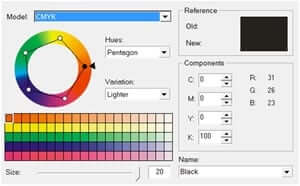
The widespread offset-printing process is composed of four spot colors: Cyan, Magenta, Yellow, and Key (black) commonly referred to as CMYK. Each spot color can be a combination of these four colors. When determining the number of colors available on a printing press, coatings, waxes, adhesives and lacquers often qualify as a spot color station on the press.
When making a multi-color print with a spot color process, every spot color needs its own lithographic film. All the areas of the same spot color are printed using the same film, hence, using the same lithographic plate. The dot gain (and the screen angle and line frequency) of a spot color vary according to its intended purpose. Coatings, waxes, adhesives, white layers and lacquers often qualify as a spot color station on the printing press, as they share the characteristics of requiring a separate lithographic film and print run. As a result, a ten color press may use three stations for coatings and only have 7 stations available for actual design.
 Source: Wikipedia
CMYK (4 color process) Color Model
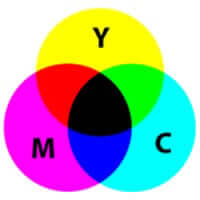
The CMYK color model (process color, or four color) is a subtractive color model used in color printing, and is also used to describe the printing process itself. CMYK refers to the four inks used in some color printing: cyan, magenta, yellow, and key (black). Though it varies by print house, press operator, press manufacturer, and press run, ink is typically applied in the order of the abbreviation.
The black “K” in CMYK stands for key because in four-color printing, cyan, magenta, and yellow printing plates are carefully keyed, or aligned, with the key of the black key plate, or outline.
Four-color process is used to get the various combinations of colors necessary for “photographic” color.
 Source: Wikipedia
Pantone Matching System (PMS)
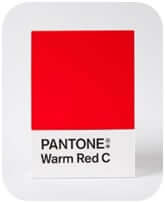
PMS is a standardized color reproduction system. By standardizing the colors, different manufacturers in different locations can all refer to the Pantone system to make sure colors match without direct contact with one another. Most of the Pantone system’s 1,114 spot colors (including metallic and fluorescents) cannot be simulated with CMYK but with 13 base pigments (14 including black) mixed in specified amounts.
Pantone colors are described by their allocated number (typically referred to as, for example, “PMS 130”). PMS colors are almost always used in branding and in addition to inks and printing can be used in plastic resin colorant to carry the same color standard across the package and its decoration.
 Source: Wikipedia
RGB Color Model
RGB color model is an additive color model in which red, green, and blue light are added together in various ways to reproduce a broad array of colors. The name of the model comes from the initials of the three additive primary colors, red, green, and blue.
The main purpose of the RGB color model is for the sensing, representation, and display of images in electronic systems, such as televisions and computer monitors. Designing for packaging should NOT been done using the RGB model.
 Source: Wikipedia
Modern Digital Color Matching Tools
Today's color printing and packaging teams increasingly rely on digital tools to keep spot color, CMYK, and Pantone matching consistent across runs. A spectrophotometer can measure a physical color sample and match it to the closest standardized Pantone or CMYK equivalent in seconds, while ICC color profiles help ensure that what appears on a monitor translates accurately once it reaches the press for color printing. Many print houses now also offer digital soft-proofing, letting brand teams approve color on screen before committing to a physical run, which can reduce material waste and turnaround time.
- Use a spectrophotometer to verify Pantone or CMYK matches before a full print run
- Ask your printer whether they support digital soft-proofing to cut down on physical proof cycles
- Store approved ICC color profiles so repeat print jobs stay consistent across vendors
- Compare digital swatch libraries against physical Pantone books, since screen colors can still drift from press output
Choosing the Right Color Model for Your Project
When preparing artwork for print or packaging, picking the correct color model early helps avoid costly mismatches between what's on screen and what comes off the press. Spot colors and the Pantone Matching System offer the most consistency for brand colors, while CMYK is the standard for full-color, photographic images. RGB should stay reserved for on-screen use only, since it can't be accurately reproduced on a printing press.
- Use spot colors or PMS numbers when brand color consistency matters most
- Convert RGB artwork to CMYK before sending files to print to avoid color shifts
- Remember that coatings, waxes, and lacquers can each take up a spot color station on press
- Ask your printer how many color stations are available before finalizing a multi-color design
- Keep packaging artwork in CMYK or Pantone color mode, never RGB
FAQs
What is a spot color in printing?
A spot color is any color generated by a pure or mixed ink that's printed using a single run and its own lithographic film.
What does CMYK stand for?
CMYK stands for cyan, magenta, yellow, and key (black) — the four inks used in four-color process printing.
What is the Pantone Matching System (PMS)?
PMS is a standardized color reproduction system that lets manufacturers in different locations match colors consistently, using a set of base pigments.
Should the RGB color model be used for packaging design?
No — RGB is meant for electronic displays like TVs and monitors, so packaging design should avoid the RGB model.
Why might a ten-color press only have seven stations available for design?
Because elements like coatings, waxes, adhesives, and lacquers can each take up their own spot color station, leaving fewer stations for actual design colors.