262-250-7566
 Request a quote
News & insights.
What we’re learning, what we’re seeing, and the occasional story from the floor: packaging trends, supply-chain notes, and compliance updates we wish we’d known sooner.
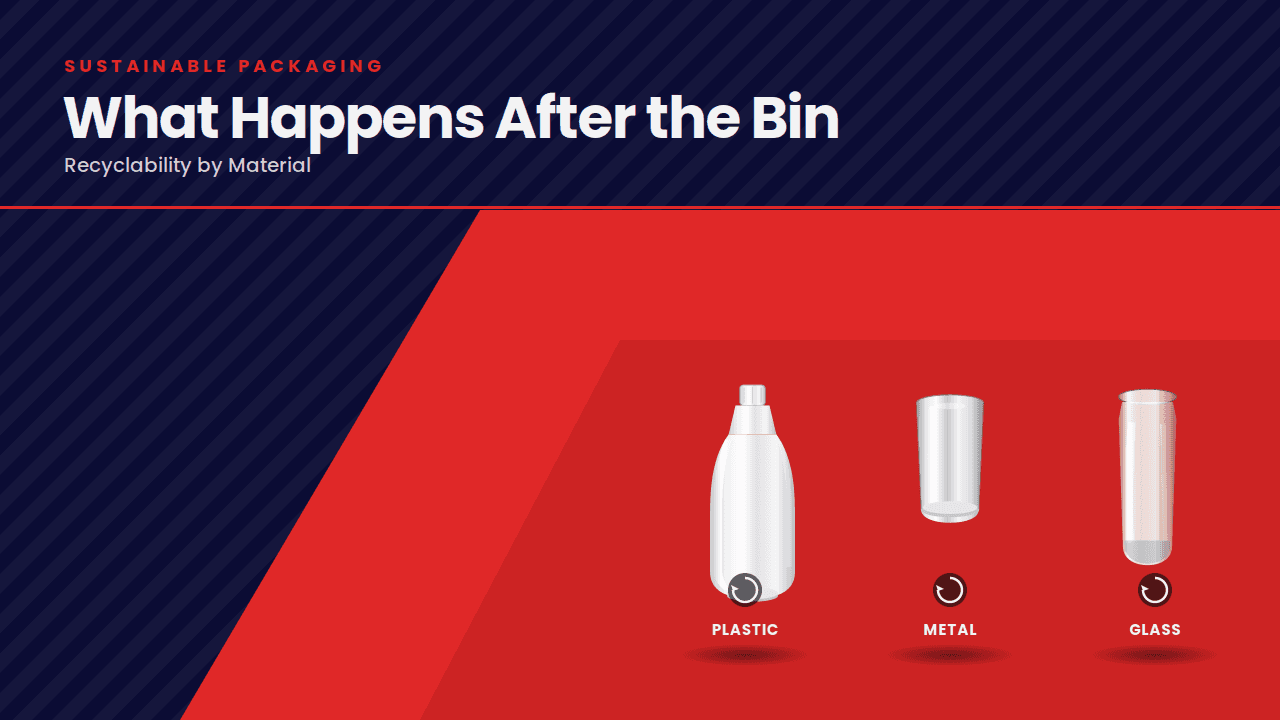
What Happens After the Bin Recyclability by Material

Table of Contents
Every material in rigid packaging has a different date at the end of life. This guide walks through how each one gets recycled, what limits it in practice, and what to watch for if recyclability matters to your packaging decision.
Recyclability isn't just a resin code stamped on the bottom of a container; it's a question of whether a material is collected, sorted, and reprocessed where your product ships. The same material can be highly recyclable in one municipality and essentially landfill-bound in another. This guide covers the materials from our Packaging Materials Reference Guide, one section per material, focused specifically on what happens to each one at end of life: how it's identified, how it's recycled in practice, and where the real-world limits are.
A note on how to read this: the rating badge on each section is a practical read on how reliably that material gets recycled in a typical curbside or industrial recovery system, not a claim about what's technically possible in a lab. For a full look at how material fits alongside container type, closures, and decoration, see our Complete Guide to Rigid Packaging. For a broader look at how we approach sustainability across our packaging, visit our Sustainability Page.
Plastics
HDPE (High-Density Polyethylene) - Widely Recyclable
HDPE is the most reliably recycled rigid plastic in the packaging world, and it's not close. It carries resin identification code #2, and natura. Uncolored HDPE is the easiest and most valuable stream for a material recovery facility to sort - colored and pigmented HDPE is still recyclable, but it sorts and sells separately at a lower grade. Once collected, it's cleaned, shredded, and melted into pellets at high volume, and recovered HDPE commonly comes back as new bottles, pipes, lumber-alternative decking, and crates.
Where this breaks down in practice is downcycling and contamination. Pigmented and multi-layer HDPE containers tend to end up in lower-grade uses rather than looping back into new food-contact bottles, and residual product left inside a container is one of the most common reasons an otherwise - recyclable load gets rejected at the sorting stage.
Polyethylene: LDPE, LLDPE, and MDPE - Recyclable, access varies
The lower-density polyethylene is technically recyclable, but curbside access lags well behind HDPE. They fall under resin code #4, and MDPE is the one most likely to get swept in alongside HDPE where a facility's sorting equipment groups the polyethylene together; film-form LDPE, by contrast, is almost never accepted in standard curbside bin and typically needs a dedicated drop-off program instead.
When rigid LDPE or MDPE components are collected, they reprocess mechanically much like HDPE does. The practical risk is that because these resins are less commonly accepted in standard programs, a rigid component made from LDPE or LLDPE can quietly end up landfilled even in a system that otherwise recycles HDPE well. If recyclability matters for your product, MDPE is the safer bet of the three.
Polypropylene (PP) - Recyclable, access varies
PP is technically straightforward to recycle, but collection has historically trailed HDPE and PET. It carries resin code #5, and because PP also doubles as the standard closure and cap material even on containers made from other resins, a lot of it re-enters the recycling stream attached to a different base material rather than on its own. Recovered PP is reprocessed into pellets for automotive parts, buckets, totes, and new PP packaging, and curbside acceptance for rigid PP containers has expanded meaningfully in recent years, though it's still not universal.
That's the main thing to watch to confirm local acceptance before assuming a PP container is curbside recyclable, since it's an easier assumption to get wrong than with HDPE or PET. Caps and closures are generally recyclable but are sometimes screened our if they aren't separated from the container before collection.
PET (Polyethylene Terephthalate) - Widely Recyclable
PET is the most recycled plastic in the world, with genuine bottle-to-bottle circularity in many markets. It's resin code #1, and clear PET is the most valuable and most sought-after stream by reclaimers, which is a large part of why it recycles so consistently well. Recovered PET is cleaned, flaked, and reprocessed into food-grade recycled PET (rPET) for new bottles, as well as fiber for textiles and carpet, with closed-loop bottle-to-bottle recycling well established at scale.
Colored and opaque PET recycles at a lower rate and lower value than clear PET, so that's worth factoring in if presentation calls for tint. The bigger watch-out is PVC contamination: even small amounts of PVC mixed into a PET stream are hard to fully separate and can ruin an entire batch of recycled PET, which is one reason the two materials are treated no differently by recyclers.
Other Plastics: PVC, Polystyrene, and Barrier Resins - Limited Recyclability
This group covers the specialty resins with the least reliable end-of-life paths in the guide. PVC (resin code #3) is rarely accepted in curbside programs and is actively unwanted in PET recycling streams. Since it contaminates PET batches, recycling it generally requires a dedicated specialty stream rather than a standard municipal one. Polystyrene (resin code #6) is technically recyclable but is collected in relatively few municipal programs, and low-density or foamed forms are especially uneconomical to collect and transport.
Barrier resin and multi-layer constructions are the hardest cases in the whole guide. Bonding two or more different resin together to get a performance benefit generally means the layers can't be economically separated afterward, so the whole component is typically treated as non-recyclable regardless of what any individual layer would be on its own. If recyclability is a priority, a barrier of resin is usually a tradeoff you're making deliberately, not one you're stumbling into.
Metals
Steel - Widely Recyclable
Steel is one of the most recycled materials on the planet, packaging included. It needs no resin code, steel is magnetic, which makes it trivially easy for a material recovery facility to pull out of a mixed stream automatically. Once recovered, it melts down and reforms with no loss of material quality, again, and it routinely comes back as new steel packaging, construction materials, or automotive parts.
Interior coatings and linings used to protect steel drums from corrosive content don't reduce the recyclability of the steel itself. The main practical consideration is simply making sure drums are as empty and clean as possible before they go into the recycling stream.
Tinplate - Widely Recyclable
Tinplate recycling on the same easy path as steel, with the tin as a bonus recovery. Like steel, it's magnetic and gets automatically separated at recovery facilities without needing to be hand-sorted or optically scanned. The steel base reprocesses exactly like any other steel scrap, while the thin tin coating is recovered separately during processing rather than lost, adding a small amount of extra recovery value.
This is one of the most consistently well-recycled materials in this entire guide. The main thing worth doing is making sure cans and pails are empty and reasonably clean before they're collected.
Aluminum - Widely Recyclable
Aluminum is infinitely recyclable and among the most valuable materials in the entire recycling stream. It's non-magnetic, so it's sorted using eddy current separation, a step nearly every modern material recovery facility already runs. From there it's remelted with no degradation in quality, using a fraction of the energy needed to produce new aluminum from raw ore, and its high scrap value means an aluminum recycling is economically self-sustaining in almost every market.
Internal coating, sometimes needed for product compatibility, is a minor consideration during reprocessing but doesn't meaningfully change the overall picture, aluminum remains one of the best recycled materials in this guide.
Fiber & Glass
Fiber - Recyclable, access varies
Fiber recycles well in its plain paperboard form, but real-world drums are rarely just paperboard. There's no resin code involved - fiber is identified and sorted as a paper-based material, and only the paperboard itself is recyclable through standard paper streams. Uncoated, unlined paperboard pulps and reprocesses like any other recycled paper product, and fiber drums built for dry goods with minimal additional components recycled the most readily.
The complication is that fiber drums are commonly built with metal or plastic tops, bottoms, and liners to whatever product they hold, and those components generally need to be separated out before the paperboard portion can be recycled at all. A drum built with a moisture liner or wax coating for protection is usually not recyclable as a whole unit, even though the base material technically is.
Glass - Widely Recyclable
Glass is infinitely recyclable with no loss of quality or purity, the same trait that makes it valuable as packaging in the first place. There's no resin code here either, glass is sorted by color instead, since clear, green, and brown streams each have their own resale value, and color-mixed glass (sometimes called three-mix) is worth less. Once sorted, it's crushed into cullet and remelted into new glass containers indefinitely, without any degradation to clarity or strength, and closed-loop glass-to-glass recycling is common and well established.
Glass's own weight and breakability work against it in the recycling chain. Breakage during collection and transport can contaminate other streams or send otherwise-recyclable glass to landfills as unsortable shards, so where local collection infrastructure is weak, glass's real-world recycling rate can lag well behind its theoretical 100% recyclability.
Putting it Together
Recyclability on paper and recyclability in your customer's recycling bin are two different things. HDPE, PET, steel, tinplate, aluminum, and glass are the materials most likely to get recycled in a typical program today. PP and the lower-density polyethylene are recyclable but access-dependent. PVC, polystyrene, multi-layer barrier resins, and lined or coated fiber are the materials where recyclability is the expectation rather than the rule.
At ILLING, we work through the tradeoff with you directly, across materials and manufacturers. See our Packaging Materials Reference Guide for the full picture of how each material performs beyond end of life, or our Complete Guide to Rigid Packaging for how material fits alongside container type, closures, and decoration.
FAQs
Does a Resin Code Guarantee a Material is Recyclable?
No. A resin code identifies the material, but whether it's actually recycled depends on whether your local municipality or facility collects, sorts, and reprocesses that resin. The same code can mean widely recyclable in one area and essentially non-recyclable in another.
Which Rigid Packaging Materials Are the Safest Bet for Recyclability?
HDPE, PET, steel, tinplate, aluminum, and glass are the most consistently recycled materials across typical curbside and industrial recovery systems. PP and lower density polyethylene's (LDPE, LLDPE, MDPE) are recyclable but access varies more by region.
Why Do Multi-Layer or Barrier Packaging Components Hurt Recyclability?
When two or more different resins are bonded together for performance reasons (like a moisture barrier), they typically can't be economically separated during reprocessing. That means the whole component is usually treated as non-recyclable, even if each individual layer would be recycled on its own.
Does Residual Product Left in a Container Affect Recycling?
Yes. Leftover product is one of the most common reasons an otherwise-recyclable container gets rejected at the sorting stage. Rinsing or emptying containers as much as possible before disposal significantly improves the odds it actually gets recycled.