262-250-7566
 Request a quote
News & insights.
What we’re learning, what we’re seeing, and the occasional story from the floor: packaging trends, supply-chain notes, and compliance updates we wish we’d known sooner.
Industrial Pail Buying Guide

Table of Contents
- What Is an Industrial Pail?
- Pail Sizes: Matching Capacity to Your Product and Application
- Pail Materials: HDPE vs. Steel
- Resin Grade and Wall Thickness: Why "A Pail Is Not a Pail"
- Lid Types and Closure Configurations
- UN-Rated Pails: When You Need Them and What the Rating Means
- Bail Handles: Ergonomics Matter
- Stack Strength and Pallet Configuration
- A Note on Decoration
- Putting It Together: Your Industrial Pail Buying Guide Checklist
- FAQs
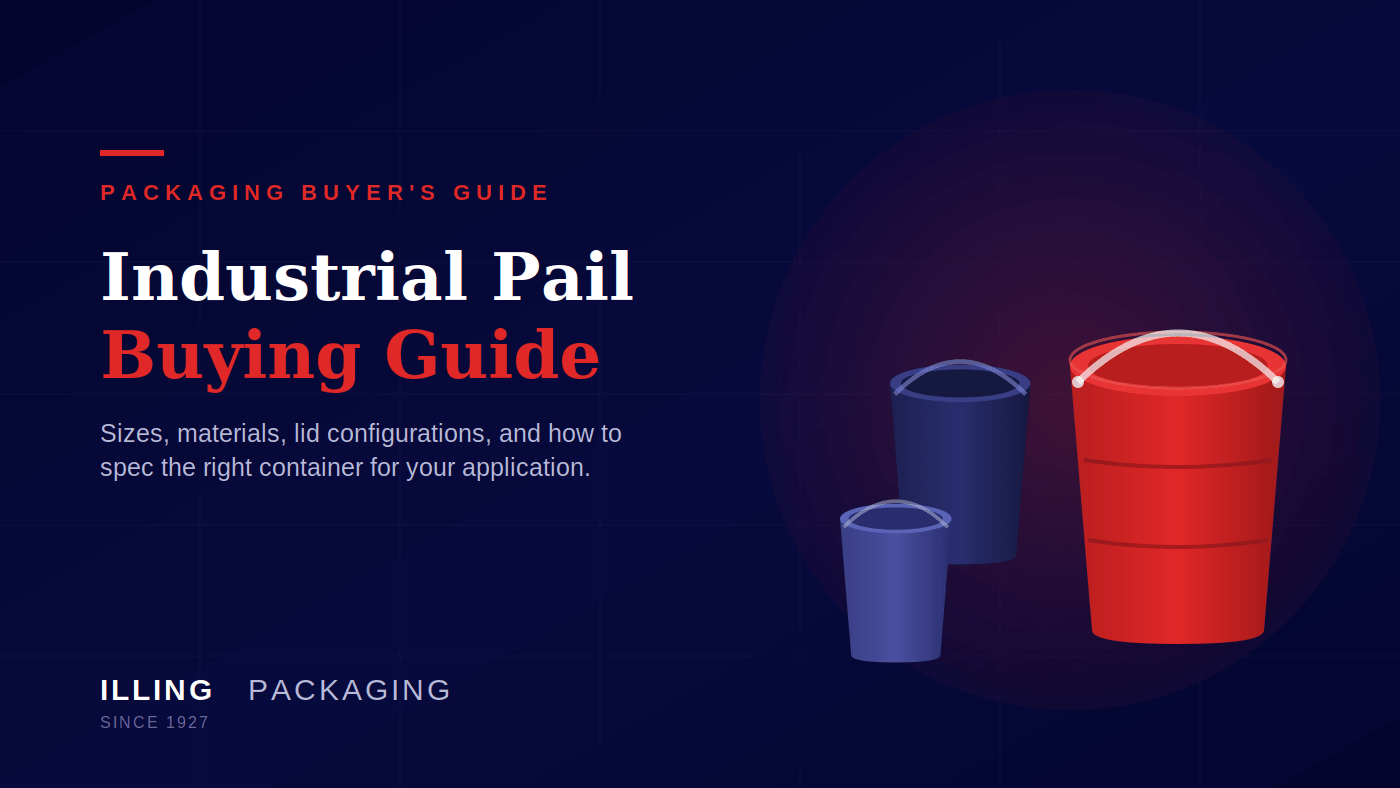
This industrial pail buying guide exists because pails are one of the most common containers in industrial packaging and one of the most underspecified. Most buyers know they need a 5-gallon pail. Far fewer know whether they need open head or tight head, lever lock or tear tab, virgin HDPE or food-grade resin, UN-rated or standard duty. And almost nobody thinks about closure torque until something leaks.
Whether you're sourcing pails for the first time or you've been buying them for years, this guide gives you the vocabulary, the framework, and a spec checklist to make sure nothing is assumed that should be specified.
What Is an Industrial Pail?
An industrial pail is a rigid, cylindrical container with a bail handle and a resealable lid, typically ranging from 1 to 7 gallons in capacity. Understanding what separates a well-specified industrial pail from a poorly specified one is what this industrial pail buying guide is built around. They are manufactured primarily from high-density polyethylene (HDPE) or steel, and they are used across industrial, commercial, and consumer applications for products that need to be stored, transported, dispensed, or applied from the container directly.
Pails are used for adhesives, coatings, lubricants, grouts, concrete products, pool chemicals, cleaning compounds, food ingredients, agricultural inputs, and dozens of other product categories. For a broader look at how pails fit into the full range of rigid packaging options, see our Complete Guide to Rigid Packaging. They're stackable, palletizable, ergonomic for field use, and available in a wide enough range of configurations to accommodate almost any product requirement.
The challenge is that "pail" covers a lot of ground. A pail used to ship a water-based coating to a contractor is a very different specification from a pail used to transport a hazardous solvent through a DOT-regulated supply chain. Getting that specification right is what this guide is for.
Pail Sizes: Matching Capacity to Your Product and Application
One of the first decisions in any industrial pail buying guide is size. Industrial pails are typically available in the following nominal sizes:
1 gallon: Used for sample quantities, specialty products, concentrated materials, and applications where the end user needs a small, manageable quantity. Common in paint, adhesive, and specialty chemical categories.
2 gallon: Less common but useful for products where a 1-gallon fill is too small and a 3.5-gallon fill is more than the end user needs. Often appears in consumer-facing and contractor-grade product lines.
3.5 gallon: A practical middle size for products sold to contractors, tradespeople, and light industrial users. Common in coatings, concrete products, and pool chemical categories.
5 gallon: The single most common industrial pail size. It's the standard for a reason: 5 gallons is the right capacity for a wide range of products, it palletizes efficiently, it fits within ergonomic weight limits for most filled products, and the supply chain for 5-gallon pails is deep and competitive.
6 gallon: Used when a 5-gallon fill at a product's density would exceed safe handling weight, or when the product formulation or fill volume requires slightly more capacity than a standard 5-gallon container provides.
7 gallon: The largest common pail size. Used for lower-density products where a higher volume can still be handled safely, or for products where overfill capacity is part of the application.
Fill Weight vs. Nominal Volume: The Calculation Buyers Miss
Pails are sized by volume, but products are sold by weight. The relationship between the two depends on your product's density, and density varies significantly across industrial chemistries.
Water weighs approximately 8.34 pounds per gallon. A water-based product in a 5-gallon pail will weigh roughly 42 pounds. A dense grout or concrete resurfacer might weigh 60 to 70 pounds in the same container. A solvent with a lower density might weigh 35 pounds.
Before you finalize a pail size, calculate the actual gross weight of your filled container: product weight plus pail weight plus lid weight. Compare that number to the pail's rated gross weight capacity. Make sure there is margin. A pail specified right at its weight limit has no room for variation in fill level, product density, or the reality that filling lines don't always hit exactly the same volume on every unit.
This is one of the most common and most preventable specification errors in industrial pail purchasing.
Pail Materials: HDPE vs. Steel
Material selection is a core chapter in any industrial pail buying guide. The two primary materials for industrial pails are high-density polyethylene and steel, and each has applications where it performs best.
HDPE Pails
HDPE is the dominant material for industrial pails across most categories. It's impact-resistant, chemical-resistant across a wide range of formulations, lightweight relative to steel, and recyclable. HDPE pails are available in a wide range of wall thicknesses and resin specifications, which means they can be engineered for applications ranging from light-duty consumer products to heavy-duty industrial chemicals.
HDPE pails are the right choice for the majority of industrial applications. They're cost-effective, widely available, and perform well against most chemistries buyers are likely to encounter.
When HDPE is the correct choice: Water-based products, most oils and lubricants, adhesives and coatings, cleaning compounds, food-grade applications using food-contact compliant resin, and most general-purpose industrial products.
When HDPE may not be sufficient: Highly aggressive solvents or aromatic hydrocarbons with significant permeation potential (see fluorinated containers below), products requiring maximum structural integrity under extreme conditions, and certain DOT hazardous material classifications that specify steel.
Steel Pails
Steel pails offer maximum impact resistance and structural integrity. They're required for certain DOT hazardous material classifications and are preferred for products with very high or very low flash points or products that require the highest level of containment.
Steel pails are heavier and typically more expensive than HDPE, which matters at volume. But in applications where steel is the correct choice, it's not a premium. It's the specification the product and the regulation require.
When steel is the correct choice: Products requiring DOT steel container certification, high flash-point or low flash-point chemistries where steel containment is specified, applications requiring maximum stack strength under heavy loads, and any application where your regulatory or safety team has specifically required steel.
Fluorinated HDPE Pails
For products with aggressive solvent chemistries, including certain fuels, aromatic compounds, ketones, and halogenated solvents, standard HDPE may not provide sufficient barrier performance. These chemistries can permeate through standard HDPE walls over time, weakening the container and allowing product to escape.
Fluorinated pails are HDPE containers that have been treated with fluorine gas to create a barrier layer on the inner surface. That barrier dramatically reduces permeation without changing the external appearance or handling characteristics of the container. If your product has permeation risk and you're not currently using fluorinated containers, it's a specification question worth raising with your supplier.
Resin Grade and Wall Thickness: Why "A Pail Is Not a Pail"
Two pails can look identical, carry the same nominal volume, both be made from HDPE, and perform very differently in the field. The reason almost always comes down to resin grade and wall thickness.
Resin grade refers to the quality and specification of the raw material used to produce the pail. Virgin resin, meaning material that has never been processed before, produces containers with more consistent mechanical properties than containers made with recycled or regrind content. For most industrial applications, virgin resin is the right specification.
Wall thickness determines impact resistance, compression strength, and the pail's ability to handle the weight of its contents and the load of stacked containers above it. Thicker walls cost more per unit. They also fail less often. For products at the high end of the weight range for a given pail size, thicker walls are not optional. They're the specification that keeps the container performing through its full distribution life.
When comparing pail quotes from multiple suppliers, ask specifically about resin specification and wall thickness. A lower unit price that reflects thinner walls or a lower resin grade will look attractive on the purchase order. It will look considerably less attractive when containers fail on the production floor or in the field.
Lid Types and Closure Configurations
The lid is the most functionally critical component of a pail system. It determines whether the container seals properly, whether it can be resealed after opening, whether it meets tamper-evidence requirements, and whether it complies with any child-resistant closure regulations that apply to your product.
Open Head vs. Tight Head
Open head pails have a fully open top sealed by a separate lid. This is the standard configuration for most industrial pails. The lid snaps, levers, or threads onto the pail and can be removed and replaced for products that are dispensed in multiple uses.
Tight head pails have a fixed top with a small bung opening, similar to a drum, for filling and dispensing. They're less common in pail formats than in drums but do appear in certain specialty applications where a sealed top provides additional containment integrity.
For most industrial pail applications, open head is the correct and standard configuration.
Lever Lock Lids
A lever lock lid uses a metal locking ring that snaps over the lid and the rim of the pail, creating a secure closure that requires a tool or deliberate effort to remove. Lever lock lids are appropriate for:
Products that need an airtight or tamper-evident seal. Products that will be shipped through a distribution chain and need to remain sealed until the end user opens them. Products where resealing between uses is important for shelf life or product integrity.
Lever lock lids are the most common closure for industrial pails used in supply chain applications.
Tear Tab Lids
A tear tab lid incorporates a one-time-use tab that must be broken or removed to open the lid, providing a clear visual indicator of whether the container has been previously opened. They're appropriate for products where tamper evidence is required or preferred, and for products that are used in a single session rather than dispensed over multiple uses.
Once the tear tab is removed, the lid can typically be reclosed but no longer provides tamper evidence.
Child-Resistant Closures
Certain products are required by federal regulation to use child-resistant packaging. This includes many pesticides, certain pool chemicals, and other products regulated under the Poison Prevention Packaging Act. Child-resistant closures on pails typically require a specific press-and-turn or squeeze-and-turn mechanism that makes the closure difficult for young children to open.
If your product is regulated under PPPA or falls into a category that commonly triggers child-resistant packaging requirements, confirm with your regulatory team whether your pail closure needs to meet child-resistant standards before you finalize your specification.
Snap-On Lids
Snap-on lids close by pressing down onto the pail rim without a locking ring. They're faster to open and close than lever lock lids and appropriate for products where ease of access is more important than a highly secure seal. Common in consumer-facing and contractor-grade applications where the end user is opening the container frequently.
UN-Rated Pails: When You Need Them and What the Rating Means
If your product is classified as a hazardous material under U.S. DOT regulations, your pail must carry the appropriate UN certification for the hazard class and packing group of your specific product.
A UN-rated pail has been independently tested to meet performance standards established by the United Nations for the transport of hazardous materials. The UN marking on the pail tells you everything about what the container has been tested and authorized to carry: container type, material, performance level, maximum gross weight, and year and country of manufacture.
The performance level, marked as X, Y, or Z on the container, corresponds to packing groups under DOT regulations. X covers Packing Groups I, II, and III. Y covers Packing Groups II and III. Z covers Packing Group III only. Matching the right performance level to your product's packing group classification is a regulatory requirement.
For a full breakdown of how to read a UN marking, see our guide to How to Read a UN Certification. For a plain-language overview of DOT hazmat classification and what it means for your packaging program, see our DOT Packaging Compliance 101 guide.
What to know as a buyer: If your product is a hazardous material, start your pail specification with the UN rating requirement, not with the container. The rating your product requires determines the container that can legally carry it, not the other way around.
Bail Handles: Ergonomics Matter
The bail handle on an industrial pail is the primary means by which the container is carried, from a pallet to a production line, from a truck to a jobsite, from a shelf to a workspace. Handle design affects ergonomics, durability, and user experience in ways that matter more than most buyers initially account for.
Steel bail handles are standard on most industrial pails and are appropriate for the majority of applications. Plastic bail handles are lighter and used in consumer-facing applications where the slightly lower weight and cleaner appearance are preferred.
For filled pails at the higher end of the weight range, particularly 5-gallon and 6-gallon pails filled with dense products, the handle needs to be rated for the gross weight of the filled container. Confirm handle weight ratings with your supplier for heavy-fill applications.
Stack Strength and Pallet Configuration
Pails in a production and distribution environment spend a significant portion of their life stacked. Understanding stack strength and pallet configuration before you commit to a pail specification can save meaningful freight and warehousing cost at volume.
Stack strength is the maximum vertical load a pail can sustain without deforming. A pail that deforms under stack load can fail its seal, damage the product, and create a safety hazard in a warehouse environment. Stack strength specifications are published by pail manufacturers and should be verified against the actual stacking conditions in your operation.
Pallet configuration refers to how many pails fit on a standard pallet in a single layer, and how many layers can be stacked safely. Optimizing pallet configuration, meaning the number of pails per pallet and the number of tiers, is a direct lever on freight cost. More units per pallet means lower freight cost per unit. It is worth asking your supplier for pallet configuration data before finalizing a pail size or format.
A Note on Decoration
For many products packaged in pails, the decoration on the container, whether a label, silk screen print, or shrink sleeve, is doing as much work as the container itself. It's the first impression the product makes on a distributor, a contractor, or an end user. It carries regulatory and safety information that may be legally required. And it represents the brand every time the container is seen, handled, or photographed.
Sourcing your pail and your decoration through the same partner eliminates a handoff in your supply chain and a potential point of failure. When the container and the decoration are specified and applied by the same team, quality is controlled in one place and lead times don't compound across two vendor relationships.
ILLING sources industrial pails and applies in-house decoration, including silk screen printing, pressure-sensitive labeling, shrink sleeving, and RFID labeling, so your container arrives ready for production. If your current process involves sourcing containers from one supplier and sending them to a decorator separately, that's a conversation worth having.
Putting It Together: Your Industrial Pail Buying Guide Checklist
Before you place a pail order, you should be able to answer every item on this list:
- What is the nominal volume of the pail?
- What is the actual gross weight of the filled container, and does it fall within the pail's rated gross weight capacity with appropriate margin?
- Is the pail material HDPE, steel, or fluorinated HDPE, and is that material appropriate for your specific product chemistry?
- What resin specification and wall thickness does the pail meet?
- Is the lid type appropriate for your application: lever lock, tear tab, child-resistant, snap-on?
- Does your product require a UN-rated pail, and if so, what performance level and packing group does the rating need to cover?
- Has chemical compatibility between your product and the pail material been verified?
- What decoration method will be used, and is it specified at the same time as the container?
- What is the supplier's lead time and minimum order quantity?
- Is there a stocking agreement or safety stock arrangement in place for your highest-volume pail SKUs?
If any of those questions don't have a clear answer, that's where the conversation with your supplier starts.
ILLING has been specifying and sourcing industrial pails for 100 years. If you're working through a pail specification and want a second set of eyes, or if you're looking for a supplier who can handle both the container and the decoration, we'd like to hear about it. Not sure what to look for in a packaging supplier? See our guide to How to Evaluate a Packaging Supplier.
FAQs
What is the most common industrial pail size, and is it right for my product?
The 5-gallon pail is the standard across most industrial categories, and for good reason. It palletizes efficiently, fits within ergonomic weight limits for most filled products, and the supply chain for 5-gallon pails is deep and competitive. That said, "most common" doesn't mean "always correct." If your product is dense enough that a 5-gallon fill would exceed safe handling weight, grouts, concrete products, and heavy coatings frequently fall into this category, a smaller pail size may be the better specification. Run the fill weight calculation before you default to 5 gallons: multiply your product's weight per gallon by the fill volume, add pail and lid weight, and confirm the total sits comfortably within the pail's rated gross weight capacity.
What's the difference between a lever lock lid and a tear tab lid, and how do I know which one I need?
Both provide a degree of tamper evidence, but they serve different use cases. A lever lock lid uses a metal locking ring to create a secure, resealable closure. It's the right choice when your product will be opened and resealed multiple times, or when a consistently airtight seal is critical for shelf life or product integrity. A tear tab lid has a one-time-use seal that provides clear visual evidence of whether the container has been previously opened, but once the tab is removed the container no longer provides tamper evidence. If your product is used in a single session and tamper evidence at point of sale is the priority, tear tab is often the simpler and more cost-effective choice. If the product is dispensed over multiple uses and seal integrity between uses matters, lever lock is the right call.
How do I know if my product requires a UN-rated pail?
Start with your product's DOT classification. If your product is a hazardous material under U.S. DOT regulations, which covers a broad range of industrial chemicals, flammable liquids, corrosives, oxidizers, and other categories, it must be shipped in a container that carries the appropriate UN certification for its hazard class and packing group. If you're not certain whether your product is a DOT-regulated hazardous material, don't assume it isn't. Many common industrial products carry a hazmat classification that their manufacturers aren't fully aware of until a carrier flags it. Your packaging supplier should be able to help you work through the classification question, and ILLING's team does this regularly with industrial customers.
What's the risk of using a lower-cost pail with thinner walls or a lower resin grade?
The risk is real and tends to show up at the worst possible time. Thinner walls reduce impact resistance and compression strength. A pail that passes receiving inspection may still fail when it's dropped on a production floor, stacked three pallets high in a warehouse, or subjected to temperature variation in transit. Lower-grade resin introduces more variability in mechanical properties, which can affect seal integrity, chemical resistance, and shelf life performance in ways that aren't visible until the pail is already in the field. The cost difference between a well-specified pail and a cheaper alternative is often measured in cents per unit. The cost of a failure in the field is measured in production downtime, product loss, and customer relationships. Ask your supplier specifically about resin grade and wall thickness before comparing quotes on unit price alone.
Can I source my pails and my decoration from the same supplier?
Yes, and it's worth doing. Splitting pail sourcing and decoration across two vendors creates a handoff in your supply chain where lead times compound, quality accountability is shared, and a problem at one vendor affects the other without either party being fully responsible for the outcome. When pail sourcing and decoration happen under one roof, as they do at ILLING, the container and the decoration are specified together, applied by the same team, and shipped as a finished unit. Lead times are shorter, quality is controlled in one place, and when something needs to change, there's one phone call instead of two. For brands with multiple decorated SKUs, the efficiency advantage is even more pronounced, because changeovers between SKUs are managed by the same team running the whole program rather than coordinated across separate vendor relationships.