262-250-7566
 Request a quote
News & insights.
What we’re learning, what we’re seeing, and the occasional story from the floor: packaging trends, supply-chain notes, and compliance updates we wish we’d known sooner.
IBC Totes Explained: When Bulk Makes Sense

Table of Contents
An IBC tote can transform the economics of a packaging program, or it can be an expensive, oversized mistake that ties up cash and warehouse space. The difference comes down to whether your volume and handling actually justify bulk. Many buyers move to totes too early, chasing a per-gallon saving they can't fully use, while others stay on drums long past the point where a tote would have saved them real money and labor. Knowing where that line is for your operation is the whole game.
This guide explains what an IBC tote is, the capacities and configurations available, and, most importantly, how to decide when bulk packaging makes sense and when it doesn't. By the end, you'll know whether a tote fits your volume, your product, and your handling setup. If you want broader context on the full range of container formats first, start with our Complete Guide to Rigid Packaging.
What Is an IBC Tote?
An IBC tote, short for intermediate bulk container, is a large reusable container designed for transporting and storing liquids and flowable materials in bulk. The name describes its place in the hierarchy: it sits between small containers like pails and drums and full bulk transport like tankers, hence "intermediate."
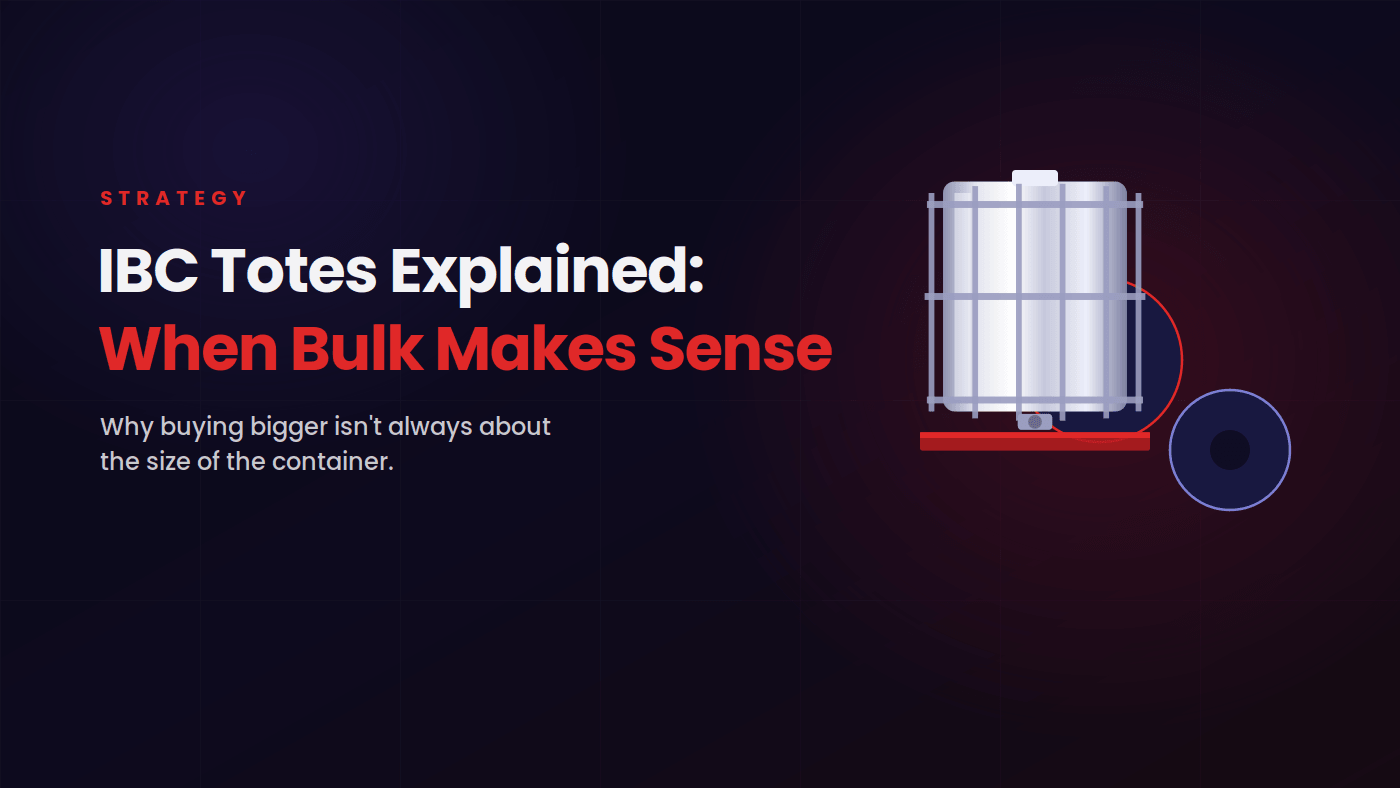
The most common design is the caged tote: a rigid HDPE bottle held inside a galvanized steel tubular cage, mounted on a pallet base for forklift and pallet-jack handling. The cage provides structural protection and stacking strength, while the inner bottle holds the product. A discharge valve at the bottom allows controlled dispensing, and a large fill opening at the top allows filling and cleaning.
The defining features of a tote are its capacity, its handling efficiency, and its dispensing design. A single tote replaces several drums worth of product in a footprint engineered for mechanical handling and bottom-discharge dispensing, which is what makes it efficient at the right volume.
IBC Tote Capacities and Configurations
Totes come in a relatively standardized set of capacities and configurations, which makes them easier to evaluate than some container categories.
| Configuration | Typical Capacity | Common Use |
|---|---|---|
| Standard caged IBC | 275 gallons (1,000 L) | Most common bulk liquid applications |
| Large caged IBC | 330 gallons (1,250 L) | Higher-volume bulk distribution |
| Rigid (non-caged) IBC | Varies | Applications needing full sidewall rigidity |
| Stainless steel IBC | Varies | Aggressive chemistries, reuse, food and pharma |
The 275-gallon caged IBC is the most common configuration by far, balancing capacity against the dimensional and weight limits of standard handling and transport. The 330-gallon version offers more volume where handling and weight allow. Stainless steel IBCs serve applications where the chemistry is too aggressive for HDPE, where extensive reuse justifies the higher cost, or where food-grade or pharmaceutical cleanliness is required.
To put the capacity in perspective, a single 275-gallon tote holds the equivalent of roughly five 55-gallon drums. That consolidation is the source of both the tote's advantages and the conditions it requires to make sense.
When an IBC Tote Makes Sense
Bulk packaging delivers real value under the right conditions. A tote makes sense when:
Your volume is high and consistent. Totes pay off when you move enough product to use a full tote within a reasonable timeframe. If you consistently consume hundreds of gallons of a product, bulk packaging starts to make economic sense.
Per-gallon cost matters at your scale. The packaging cost per gallon in a tote is typically lower than in drums or pails, because you're paying for one large container instead of many small ones. At high volume, that per-gallon difference adds up.
You have the handling equipment. Totes require forklifts or pallet jacks to move and a dispensing setup to draw product from the bottom valve. If your operation already handles palletized bulk, a tote fits naturally.
Dispensing from bulk fits your process. If your process draws product continuously or in large measured amounts, the bottom-discharge valve of a tote is more efficient than opening and pouring individual drums.
You want to reduce handling labor and waste. One tote means one container to receive, store, and dispose of or return, versus several drums. That reduces handling labor and packaging waste.
When an IBC Tote Doesn't Make Sense
Bulk isn't always the answer, and moving to totes prematurely creates its own costs. A tote usually doesn't make sense when:
Your volume is moderate or inconsistent. If you can't use a full tote within the product's shelf life, you risk product degradation, and you've tied up cash and space in inventory you can't turn over. For moderate volumes, drums often make more sense. Our Steel Drum vs. Poly Drum guide covers that decision.
You lack handling equipment. Without forklifts or pallet jacks and a dispensing setup, a tote is difficult to handle and may require equipment investment that erodes the per-gallon saving.
Your product has a short shelf life. A large container of a product that degrades quickly is a liability. If you can't consume the volume before the product turns, smaller containers reduce waste.
Your dispensing needs are small or intermittent. If you draw product in small amounts infrequently, the bulk dispensing advantage doesn't apply, and a tote's open headspace can expose the remaining product to air over a long draw-down period.
The common mistake is chasing the lower per-gallon cost without confirming you can actually use the volume efficiently. A per-gallon saving on product you can't turn over isn't a saving at all. This is a classic total cost of ownership question, which we explore in our guide to Total Cost of Ownership in Packaging.
IBC Totes and Product Compatibility
As with any container, the tote material has to be compatible with your product. The standard HDPE inner bottle is compatible with a wide range of chemistries, but the same considerations that apply to other plastic containers apply here.
Aggressive solvents and aromatic chemistries can permeate HDPE over time, and at the volume a tote holds, a permeation issue represents significant product. For those chemistries, a fluorinated HDPE tote or a stainless steel version may be the right choice. And because totes are frequently reused, the compatibility of the product with any previous contents and the adequacy of cleaning between uses become important considerations. For a full treatment of compatibility, see our guide to Chemical Compatibility Testing.
For hazardous materials, the same DOT and UN certification requirements that govern other containers apply to totes. A tote used for a regulated product must carry the appropriate certification for that product's classification, just like a drum or pail.
Where ILLING Fits In
The tote decision is fundamentally a volume and handling question, and it's exactly the kind of decision where an experienced packaging partner helps you avoid both mistakes: moving to bulk too early and staying on drums too long. ILLING has spent 100 years helping industrial manufacturers match their packaging format to their actual volume, handling, and product.
We source totes across the standard configurations, including fluorinated and stainless options for demanding chemistries, alongside the full range of drums and pails. Because we offer every format, our recommendation is driven by what your volume and operation actually justify, not by what we'd prefer to sell. We'll help you run the per-gallon and total-cost math honestly, including the handling and shelf-life factors that the per-gallon number alone misses, so the format you choose is the one that actually saves you money.
If you're weighing whether to move to bulk packaging, or whether you've outgrown drums, we'd like to hear about your volume and process and help you find the right answer.
For related guidance, see our Steel Drum vs. Poly Drum guide, our guide to Total Cost of Ownership in Packaging, and our guide to Chemical Compatibility Testing.
FAQs
What is an IBC tote?
An IBC tote, short for intermediate bulk container, is a large reusable container for transporting and storing liquids and flowable materials in bulk. The most common version is a rigid HDPE bottle held inside a galvanized steel cage and mounted on a pallet base for forklift handling, with a discharge valve at the bottom for dispensing and a large fill opening at the top. It sits between small containers like drums and pails and full bulk transport like tankers, which is where the "intermediate" in the name comes from. A single standard tote holds about 275 gallons, roughly the equivalent of five 55-gallon drums.
How many gallons is an IBC tote?
The most common tote holds 275 gallons, equivalent to 1,000 liters, which balances capacity against standard handling and transport limits. A larger configuration holds 330 gallons, or about 1,250 liters, where handling and weight allow. Other capacities exist for specialized applications, but 275 and 330 gallons are the standard sizes you'll encounter most often. For perspective, a single 275-gallon tote holds roughly the same volume as five 55-gallon drums, which is what gives totes their handling and per-gallon efficiency at the right volume.
When should I use an IBC tote instead of drums?
A tote makes sense over drums when your volume is high and consistent enough to use a full tote within the product's shelf life, when the lower per-gallon packaging cost matters at your scale, when you have the forklift or pallet-jack handling and dispensing equipment a tote requires, and when bulk dispensing fits your process. Drums make more sense when your volume is moderate or inconsistent, when your product has a short shelf life, when you lack bulk handling equipment, or when you dispense in small intermittent amounts. The key is confirming you can actually use the tote's volume efficiently, because a lower per-gallon cost on product you can't turn over isn't a real saving.
Can IBC totes be used for hazardous materials?
Yes, totes are widely used for hazardous materials, but the same DOT and UN certification requirements that apply to other containers apply to totes. A tote used for a DOT-regulated product must carry the appropriate UN certification for that product's hazard class, packing group, and gross weight, just as a drum or pail would. Additionally, because totes are often reused, the compatibility of the product with any previous contents and the adequacy of cleaning between uses are important considerations for hazardous and non-hazardous products alike. Verifying that the tote's certification matches your product's classification is the shipper's responsibility.
Are IBC totes reusable?
Yes, reusability is one of the defining features of totes, and it's part of what makes them economical at volume. A tote can typically be cleaned, inspected, and refilled many times, and reconditioning programs for IBCs are well established. Reuse does require attention to a few things: the inner bottle must be cleaned adequately between products to prevent contamination, the container must be inspected for damage, and for hazardous materials, reuse must meet the applicable regulatory requirements. Stainless steel IBCs in particular are built for extensive reuse and are common where cleaning and durability over many cycles justify the higher upfront cost.